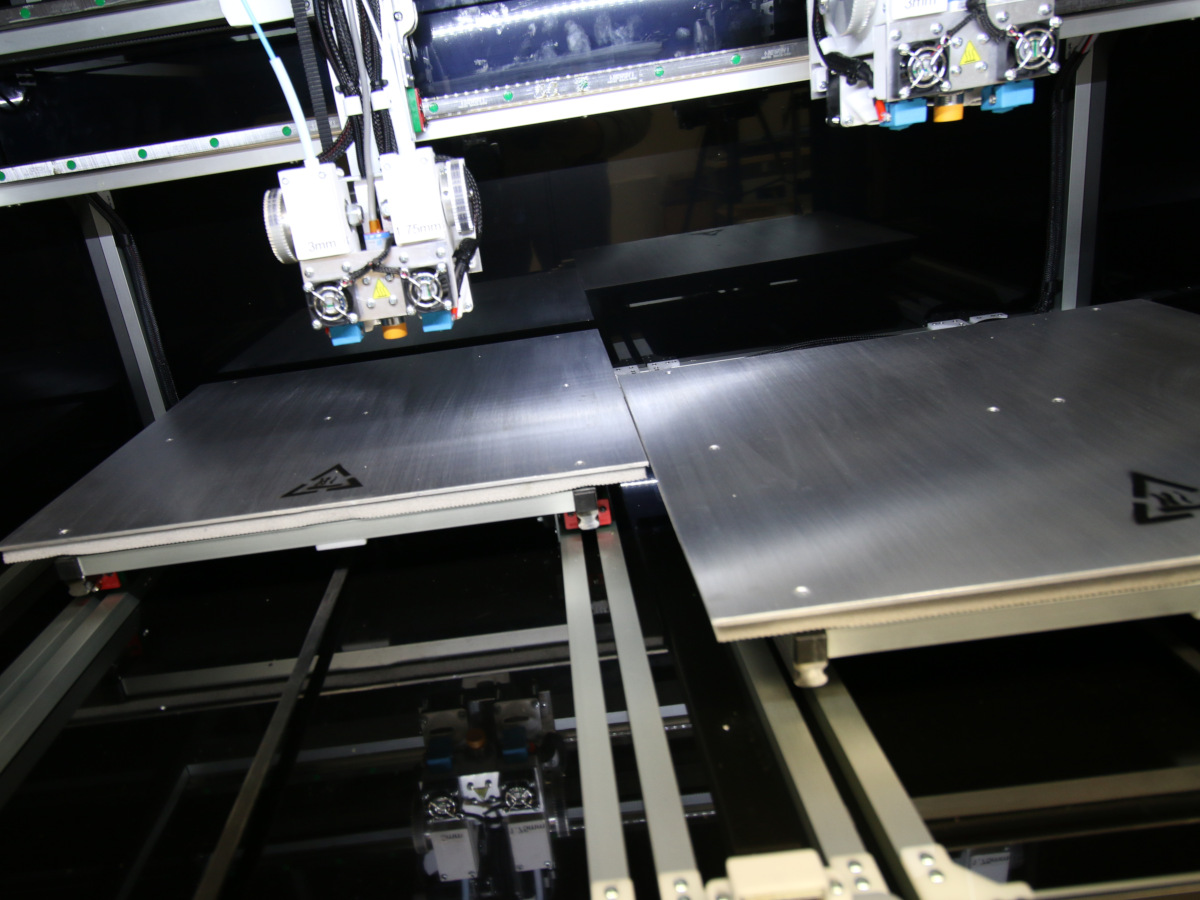
Large-format professional 3D printers have become an increasingly important technology for companies seeking new ways to produce prototypes, components, tools, and custom parts. The evolution of additive manufacturing has enabled expansion of production scales and the use of a wider variety of materials, making it possible to tackle applications that previously required more complex processes.
In the industrial field, 3D printing isn’t limited to model making. A large-format machine can be used in various phases, from prototyping and product development to the production of functional and useful components, and even small series. The choice of technology, material, and configuration always depends on the specific needs of each application.
The great interest in these systems is also linked to their ability to directly connect digital design with physical production . A CAD model can be transformed into a real component and subsequently modified to produce new versions. This flexibility allows the production process to be adapted to very different projects.
Large-scale industrial prototyping
One of the main applications of a large-format professional 3D printer is the creation of industrial prototypes.
Prototypes allow you to test various aspects of the product before starting final production. When working with large components, working at full scale can be particularly important for analyzing proportions, ergonomics, and compatibility.
3D printing allows for the production of multiple versions of the same model and relatively rapid modifications. This process facilitates the identification of potential problems in the early stages of development and helps reduce lead times.
Among the aspects that can be verified are:
- Dimensions and geometry .
- Ergonomics.
- Compatibility between components.
- Mounting systems.
- Places available.
- Exterior design.
- Accessibility and handling.
Production of functional components
Large-format 3D printing can also be used to produce functional components for specific industrial applications.
A functional component must possess the mechanical and dimensional characteristics required for its intended use. Therefore, the choice of material and manufacturing parameters is particularly important.
Depending on the application, it is possible to create supports, housings, structures, technical components, and various customized elements. The ability to produce specific geometries allows for the development of components tailored to the needs of each individual project.
Custom tools and materials
Another very interesting application is the production of tools, models and industrial equipment .
Companies may need specific solutions for certain assembly or manufacturing operations. In traditional manufacturing, developing these tools may require specific processes and preparations.
3D printing allows you to digitally design the tool and produce it directly. If the operation or dimensions change later, the model can be modified and reproduced.
This feature offers a combination of speed, customization, and flexibility that is especially useful for variable production environments.
Small series production
Limited series production is another important application.
Traditional processes can be very efficient for large quantities, but some companies only need to produce a small number of units of a particular component. In these cases, producing specific molds or tools may not be cost-effective.
Additive manufacturing allows you to produce directly from a digital file, producing only the quantities needed. It also facilitates the creation of different versions of the same component.
Custom pieces
Custom production is one of the great advantages of 3D printing.
A component can be adapted to specific dimensions, incorporate different fixing points, or respond to the particular characteristics of an installation.
The change is made to the digital model and a new production process is then generated. This allows for customized solutions without having to completely transform the production process.
This possibility is particularly interesting for companies working on special projects, niche products or applications that require different configurations.
Spare parts for maintenance
The production of spare parts can represent a useful application of industrial 3D printing.
When a component becomes unavailable or hard to source, its geometry can be reconstructed and a new unit produced using additive manufacturing, provided the material and component characteristics are suitable.
The digital model can be stored for future needs. This facilitates on-demand production and can help reduce some lead times.
In the case of large components, this possibility can be particularly interesting for unconventional elements or those intended for specific installations.
Industrial models and prototypes
Large-format 3D printing also enables the production of technical models and prototypes .
These templates can be used for presentations, project evaluation, integration studies, or pre-production testing.
The ability to create full-scale or large-scale models enables physical analysis of the product and facilitates communication between designers, engineers, production managers, and customers.
Making molds and models
In certain applications, additive manufacturing can be used to create models and molds for other processes. A full-scale model can be produced directly from a digital file and then subjected to various finishing operations as needed.
This possibility allows to reduce some of the times associated with the production of models and facilitates the creation of custom geometries.
Automotive applications
The automotive sector can benefit from large-scale 3D printing at various stages of development.
Prototypes allow you to verify shapes and dimensions, while tools and patterns can be adapted to specific operations. Additive manufacturing can also be used to develop customized components and small series, especially in special projects or during experimental phases.
The ability to quickly modify the digital model facilitates the various iterations required during development.
Applications in machinery manufacturing
In the production of industrial machinery , components can have complex geometries and considerable dimensions.
A large-format professional 3D printer can be used to create prototypes, covers, supports, tools, and some auxiliary components. Customization allows a component to be adapted to a specific machine without the need for large-scale production.
Additionally, the production of custom tools can facilitate certain assembly and maintenance operations.
Applications in industrial design
Industrial design professionals can use additive manufacturing to transform digital concepts into physical models. A large-scale prototype allows them to analyze shape, proportions, and user interaction in a way that would be difficult with a purely digital representation.
The ability to make quick changes makes it easy to experiment with different solutions before selecting the final design.
Engineering applications
In engineering, 3D printing can be used during different stages of product development.
Engineers can create working prototypes and test specific components and tools to evaluate a project’s characteristics. Direct manufacturing from the CAD model facilitates iterations and allows for physical verification of certain solutions before moving to final production.
Production of lightweight structures
One of the most interesting features of additive manufacturing is the ability to design optimized internal structures .
A large component doesn’t necessarily have to be completely solid. The interior can be designed to reduce weight and material consumption while maintaining the required characteristics for a specific application. This can be beneficial for components where stiffness, weight, and material efficiency are important factors.
Technical materials for industrial applications
The choice of material depends directly on the application. A professional 3D printer can work with various thermoplastic materials, depending on its technology and configuration.
Options used in professional applications include:
- PLA .
- ABS.
- PETG.
- Polycarbonate.
- Polyamides.
- Fiber-reinforced materials.
- Composite materials .
Engineering materials can offer specific properties of strength, stiffness or thermal stability.
The choice must be made taking into account the conditions of use and the requirements of the components.
Reinforced materials and high-performance components
Fiber-reinforced materials can expand manufacturing possibilities.
In certain applications, carbon fiber or other fibers can be used to create components with specific stiffness and strength characteristics. These solutions may be of interest for the production of tools, supports, and certain functional components.
However, they require compatible production conditions and correct machine setup.
One-piece production
One of the advantages of a large-format 3D printer is the ability to produce certain large components in a single piece.
This can reduce the number of joins and simplify some subsequent operations. Single-piece production can also facilitate prototype analysis and reduce some assembly operations.
When dimensions exceed the build volume, modular production offers an alternative.
Modular production
Modular manufacturing allows you to divide a large part into multiple sections. Each module can be optimized for production and subsequent assembly. This strategy allows you to work with components that exceed the maximum dimensions of the machine.
Furthermore, it facilitates transport and handling and allows you to modify just one section if necessary.
Production on demand
On-demand manufacturing is particularly attractive for slow-turnover components or customized pieces. A company can store the digital model and produce the component only when a specific need arises.
This system allows you to reduce some physical inventory and facilitates the production of components that are not needed on an ongoing basis.
Reducing development times
Additive manufacturing allows you to shorten some stages of product development.
The ability to go directly from the CAD model to the physical prototype facilitates testing and modifications. When the design changes, a new version can be produced without necessarily having to redo all the production-related elements.
Reduction of some costs
3D printing can help contain some prototyping and production costs , especially for one-of-a-kind pieces and limited series.
Reducing the need for specialized tools and enabling digital modification of designs can improve economic efficiency. However, the cost must be evaluated taking into account materials, energy, machine usage time, maintenance, and subsequent operations.
Automation and digitalization
Industrial applications of 3D printing are increasingly linked to automation and digitalization .
File preparation, process monitoring, and parameter standardization can be integrated into more efficient workflows.
Digitization also allows you to keep models and versions to reproduce when necessary.
3DPRN and professional applications
In the field of large-format professional 3D printing , 3DPRN is associated with solutions intended for large-scale additive manufacturing.
To choose the most suitable solution, companies must consider the characteristics of their applications. Production volume must be analyzed along with precision, compatible materials, productivity, and reliability .
There is no one-size-fits-all configuration: the solution must be adapted to the type of components and the production flow.
How to choose the right technology
Choosing a technology should begin with an evaluation of the components to be produced. Size, geometry, material, and required level of precision are key factors. It’s also important to determine whether the company primarily requires prototypes, small series, tools, or functional components.
A careful evaluation allows you to select a solution that offers the right balance between volume, quality, speed and costs .
The importance of quality control
In any industrial application, quality control must be an integral part of the process.
Depending on their intended use, finished parts may undergo dimensional checks, visual inspections, or functional tests. In small series, validating the first units can help verify process stability before proceeding with production.
The future of industrial applications
The evolution of large-format additive manufacturing will continue to expand industrial applications.
Improvements in materials, software, automation, and control will enable the production of increasingly complex components and the adaptation of technology to new needs.
The integration of digital design, simulation, 3D printing, and automation will enable increasingly flexible manufacturing processes.
The large-format professional 3D printer offers numerous industrial applications, from prototyping to the production of functional components, tools, customized parts and small series.
The ability to work directly from a CAD model speeds up development, allows for quicker modifications, and allows components to be adapted to specific needs. At the same time, the ability to produce large components significantly expands the scope of additive manufacturing.
The choice of materials, technology, and production parameters must always be based on the specifics of each project. It is also essential to consider precision, repeatability, thermal stability, and overall process cost.
From creating full-scale prototypes to on-demand production, including tools, spare parts, and small series, large-scale 3D printing can open up new possibilities for numerous industries.
In a context where companies are increasingly seeking flexibility, customization, speed and efficiency , large-format additive manufacturing represents a technology capable of integrating traditional processes and contributing to the creation of more digital and adaptable production models.